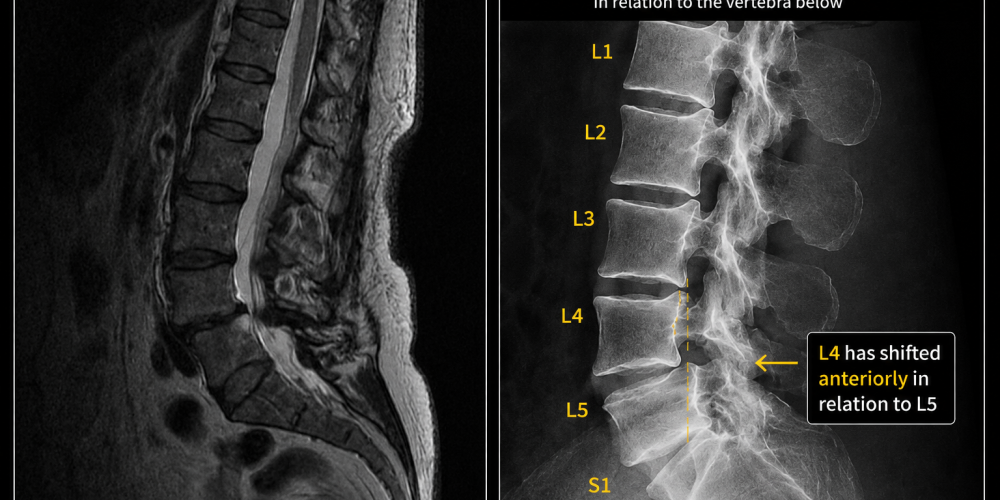
Targeted biomechanical stabilization for vertebral displacement and spinal instability.
Spondylolisthesis occurs when a vertebra slips relative to the adjacent segment—moving forward (anterolisthesis), backward (retrolisthesis), or shifting sideways (lateral spondylolisthesis). This slippage compromises spinal stability and can place direct mechanical shear stress on nerve pathways. Because structural stability is paramount with spondylolisthesis, we use precision digital imaging to grade the exact degree of slippage. From there, we design non-surgical stabilization protocols, specialized support strategies, and custom neuromuscular re-education to reduce mechanical shear stress, strengthen supporting musculature, and protect your long-term spinal health.