
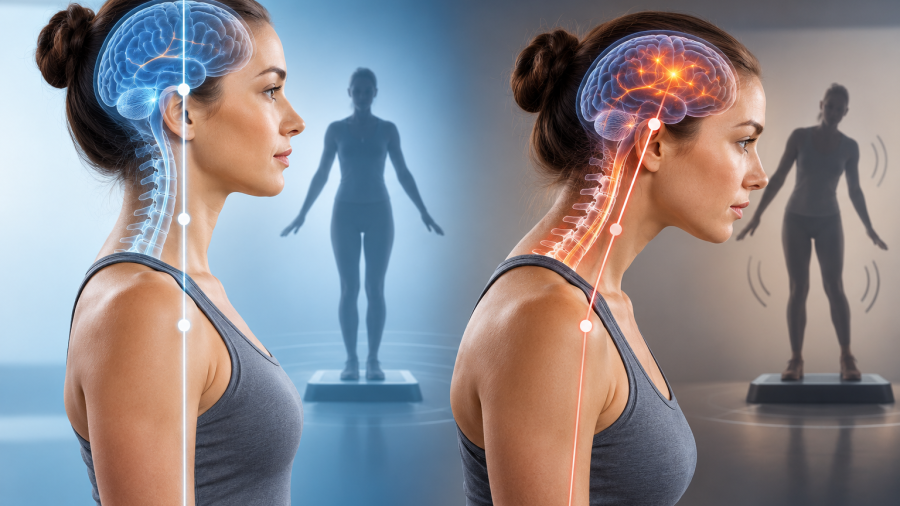
Forward head posture is often thought of as a neck or posture problem. You may recognize it as the position that develops when the head begins to drift forward in relation to the shoulders—a pattern sometimes associated with prolonged computer and smartphone use.
But new research suggests that forward head posture may involve more than just additional mechanical stress on the neck.
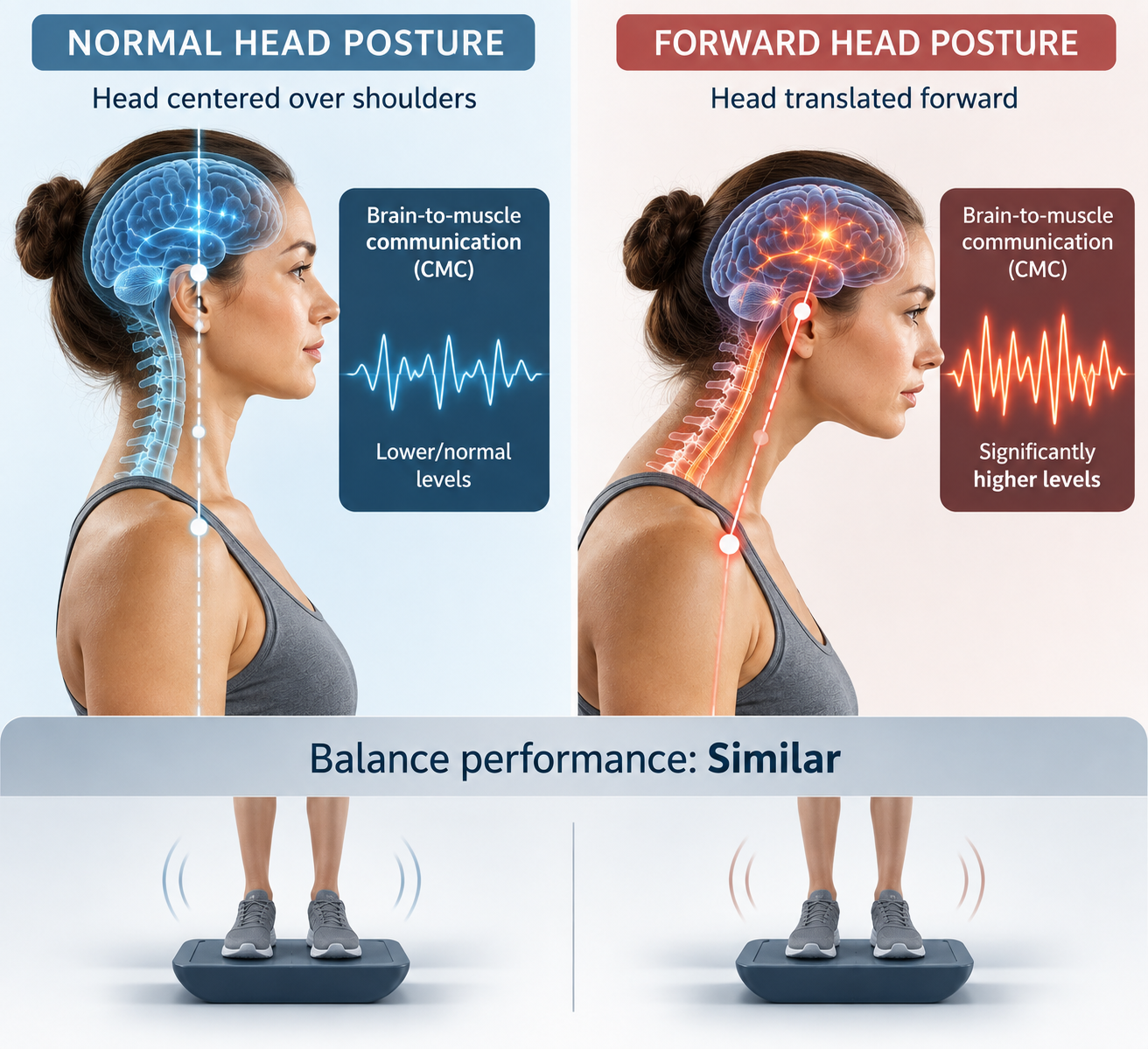
A 2025 study published in Scientific Reports examined how the brain and muscles communicate during balance tasks in young adults with and without forward head posture. Interestingly, participants with forward head posture demonstrated significantly greater corticomuscular coherence—a measure of communication between the brain’s motor cortex and working muscles—even though their actual balance performance was similar.
In other words, the participants were able to maintain balance, but those with forward head posture showed different patterns of brain-to-muscle activity while doing it.
The findings raise an interesting question: Could altered posture require the nervous system to compensate in ways we cannot see simply by looking at someone?
What Is Forward Head Posture?
Forward head posture (FHP) describes an anterior displacement of the head relative to the shoulders and trunk.
Instead of the head being positioned more directly over the body, the head translates forward. This can alter the mechanical demands placed on the cervical spine and surrounding muscles.
In the study, researchers classified head posture using the craniovertebral angle (CVA). Participants with a CVA of less than 50 degrees were classified as having forward head posture, while those with a CVA greater than 50 degrees were classified as having normal head posture.
Forward head posture can occur even in younger people who have little or no pain, which makes objective postural assessment particularly interesting.
How Did Researchers Measure the Brain’s Response?
The researchers weren’t simply looking at whether participants could stand without losing their balance.
They examined corticomuscular coherence (CMC), which evaluates the relationship between electrical activity in the brain’s motor cortex and activity in the muscles involved in a task.
The researchers used EEG to evaluate brain activity and EMG to measure muscle activity while participants completed progressively more difficult balance tasks.
These ranged from standing on a firm surface with the eyes open to more challenging conditions involving an unstable surface and closed eyes.
This allowed the researchers to investigate not only how well participants maintained their balance, but also differences in the brain-to-muscle activity associated with maintaining that balance.
What Did the Researchers Find?
The results revealed an interesting difference between how well participants maintained balance and the brain-to-muscle activity associated with doing so.
Participants with forward head posture demonstrated significantly higher peak and average corticomuscular coherence (CMC) compared with participants who had normal head posture.
Differences were identified across all five frequency bands evaluated by the researchers: delta, theta, alpha, beta, and gamma.
Even more interesting was what happened as the balance tasks became increasingly difficult. The differences in brain-to-muscle activity between the forward head posture and normal posture groups became more pronounced.
Yet despite these neurological differences, the researchers found no statistically significant difference in the Stability Index between the two groups.
In practical terms, both groups were able to perform the balance tasks similarly—but participants with forward head posture demonstrated different and generally greater patterns of brain-to-muscle coupling while maintaining that balance.
Why Is That Important?
This finding highlights something that cannot necessarily be seen simply by watching someone stand or walk.
Two people may appear to perform a physical task equally well while their nervous systems use different strategies to accomplish it.
Postural changes alter the position of the head relative to the rest of the body. Because maintaining balance requires continuous integration of information from the visual system, vestibular system, muscles, joints, and nervous system, changes in head position may influence how the nervous system coordinates postural control.
The increased corticomuscular coherence observed in participants with forward head posture may represent a compensatory strategy used by the nervous system to maintain stability despite altered head and neck positioning.
The study does not establish that forward head posture causes neurological dysfunction, cognitive problems, or fatigue. However, it provides objective evidence that forward head posture was associated with measurable differences in brain-to-muscle communication during balance tasks.
Forward Head Posture Can Exist Without Pain
Another important aspect of this research is the age of the participants.
The study included 64 young adults between 18 and 25 years old. This demonstrates why posture shouldn’t necessarily be viewed only as a problem affecting older adults or people who already have significant neck pain.
Structural and postural changes can develop before someone experiences substantial symptoms.
This is one reason objective postural assessment can be valuable. How someone feels is important, but symptoms alone do not always tell us everything about how the head, neck, and spine are positioned or how the body is adapting to those positions.
What Does This Mean for Patients?
This research adds to a growing body of evidence suggesting that posture is more than simply a cosmetic concern.
The position of the head and neck changes the mechanical relationship between the skull, cervical spine, muscles, and the rest of the body. Maintaining balance requires the nervous system to continuously process sensory information and coordinate muscular responses.
In this study, individuals with forward head posture maintained similar balance performance to those with normal head posture, but demonstrated significantly greater corticomuscular coherence during the balance tasks.
This does not mean that everyone with forward head posture has a neurological disorder or that forward head posture will necessarily cause symptoms. Instead, the findings suggest that the body may use different neurological strategies to maintain stability when head posture is altered.
For patients, this is another reason why evaluating posture objectively can provide information that symptoms alone may not reveal.
How We Evaluate Forward Head Posture at Strong Spine & Body
At Strong Spine & Body, we don’t evaluate posture simply by looking at someone from across the room.
Our examination includes a postural assessment and digital biomechanical X-rays to objectively evaluate the position and alignment of the head, neck, and spine.
For patients with measurable cervical and postural abnormalities, Chiropractic BioPhysics® corrective care may incorporate:
- Specific chiropractic adjustments
- Mirror Image® postural exercises
- Corrective spinal traction
- Neuromuscular re-education
- Individualized home exercises
- Repeat objective measurements to evaluate progress
The goal is not simply to tell someone to “sit up straight.” When a measurable biomechanical abnormality is identified, corrective care can be designed around that individual’s specific postural and spinal findings.
Recommendations are based on the patient’s examination, imaging findings when indicated, symptoms, health history, and individual clinical presentation.
Read the Original Research
The study discussed in this article was published in Scientific Reports in July 2025:
Anwar G, Moustafa IM, Khowailed I, Raghunathan MRK, Al Abdi R, Harrison DE. Comparison of corticomuscular coherence under different balance paradigms in individuals with and without forward head posture.Scientific Reports. 2025;15:22985.
The researchers evaluated 64 asymptomatic adults between 18 and 25 years old and compared corticomuscular coherence during progressively more difficult balance tasks in participants with forward head posture and normal head posture.
Read the patient-friendly research summary from CBP NonProfit.
Important: This article is provided for educational purposes and discusses findings from a scientific study examining an association between forward head posture and corticomuscular coherence during balance tasks. The study does not establish that forward head posture causes neurological dysfunction or that correcting forward head posture will produce specific neurological outcomes. Individual findings and treatment needs vary.
Add a Comment