
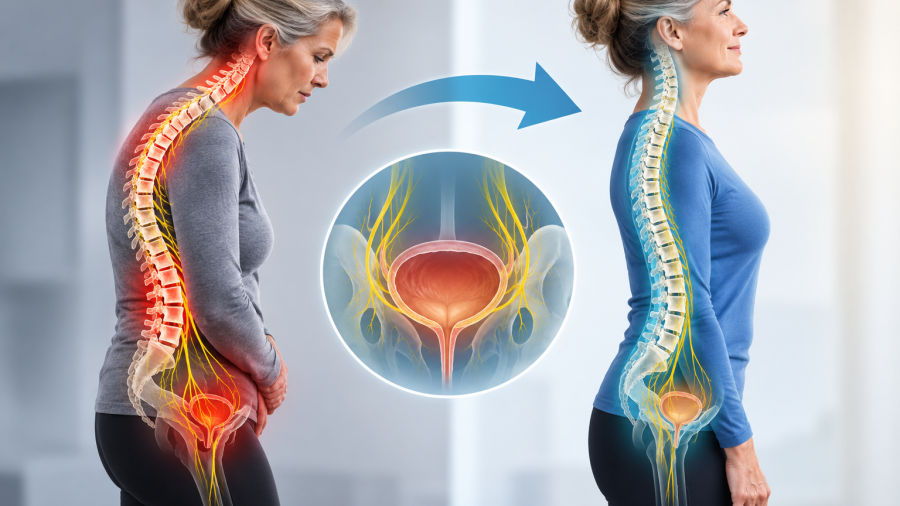
When most people think about spinal alignment, they think about neck pain, back pain, headaches, or posture. But the nervous system that travels through and exits the spine plays a much broader role in the body.
An interesting published case report involving Chiropractic BioPhysics® (CBP®) documented significant improvements in spinal alignment alongside the resolution of urinary incontinence in a 63-year-old woman.
While a single case report cannot establish that spinal correction treats urinary incontinence, the findings provide an interesting look at the potential relationship between spinal biomechanics, the nervous system, and symptoms occurring elsewhere in the body.
The Patient
The case involved a 63-year-old woman who presented with urinary incontinence as well as chronic neck, mid-back, and low-back pain.
Her evaluation included postural assessment and spinal X-rays. The examination identified several significant biomechanical abnormalities, including:
- Reversal of the normal cervical curve
- Forward head posture
- Abnormal lateral translation of the torso
- Additional spinal alignment abnormalities
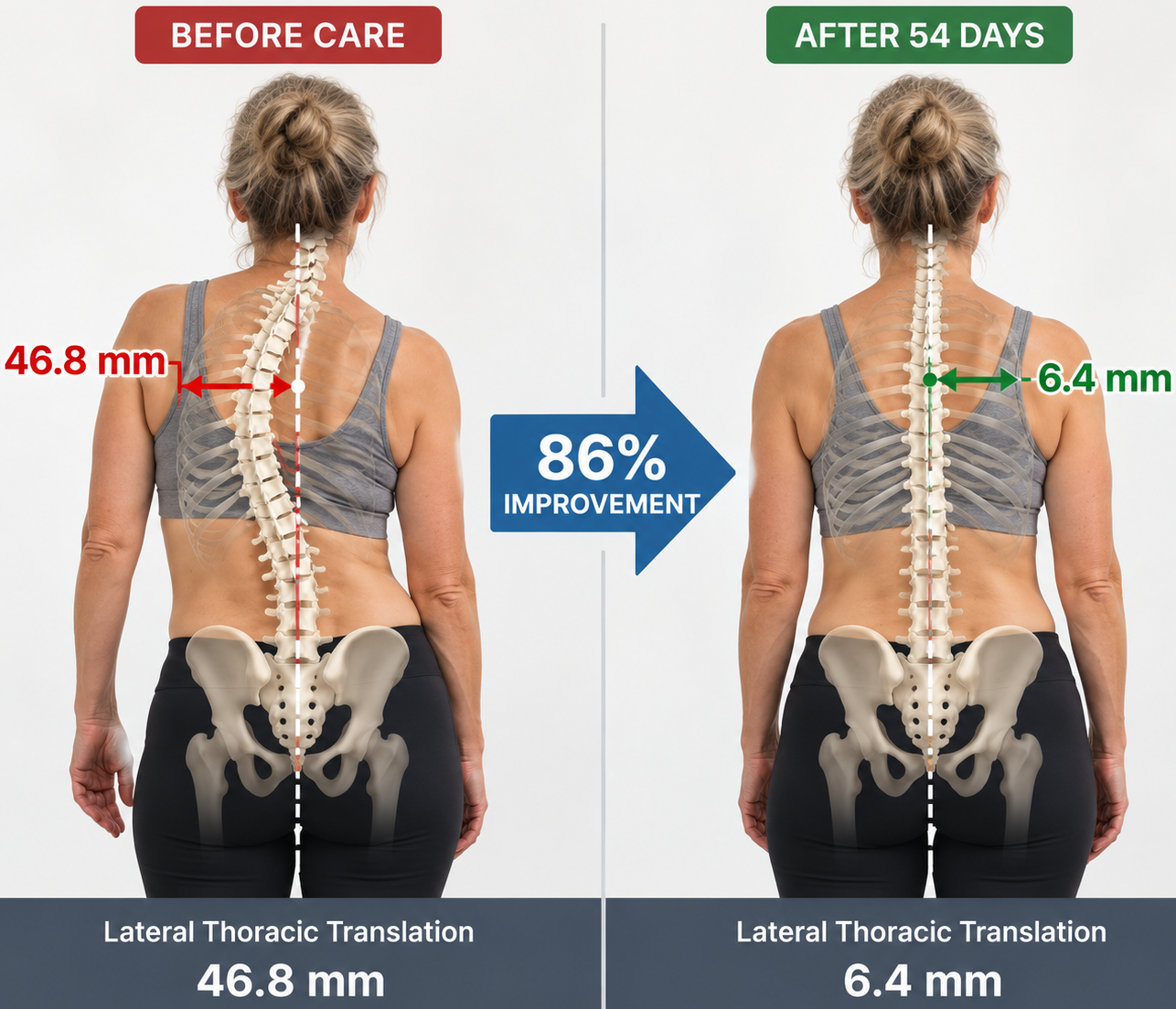
One of the most significant findings was a 46.8 mm lateral translation of the thoracic cage relative to the pelvis.
Rather than focusing only on where the patient experienced symptoms, her care plan was designed to address the measurable structural abnormalities identified during her examination.
The Chiropractic BioPhysics® Approach
The patient underwent 22 visits over 54 days.
Her care incorporated several procedures, including chiropractic adjustments, corrective spinal traction, and postural exercises. The corrective procedures were selected according to the patient’s individual postural and radiographic findings.
This is an important aspect of Chiropractic BioPhysics® care.
CBP® is a structural approach to chiropractic that uses objective measurements of posture and spinal alignment to help determine appropriate corrective procedures. Depending on the individual patient, treatment may incorporate adjustments, Mirror Image® exercises, and spinal remodeling traction.
The objective isn’t simply to provide temporary symptom relief. When clinically appropriate, the goal is to improve measurable abnormalities in spinal alignment and posture.
What Happened After 54 Days?
Following 22 visits, repeat evaluation and X-rays demonstrated substantial changes.
The patient’s lateral thoracic translation improved from 46.8 mm to 6.4 mm, representing an approximately 86% improvement in that particular alignment measurement.
The authors also reported:
- Complete resolution of urinary incontinence
- Complete resolution of neck and low-back pain
- Mid-back pain reduced to minimal levels
- Improvement in cervical spinal alignment
- Discontinuation of the patient’s overactive-bladder medication
These changes occurred during the same period in which substantial changes in the patient’s spinal alignment were documented.
What Could the Spine Have to Do With Bladder Function?
Bladder control involves a complex interaction between the brain, spinal cord, peripheral nerves, pelvic floor, and urinary system.
The authors of the case report proposed that significant spinal displacement and altered spinal geometry could potentially influence neurological function through abnormal mechanical stresses on neural tissues.
Correcting abnormal spinal alignment, therefore, was proposed as one possible explanation for the neurological improvement observed in this patient.
Why This Case Is Still Interesting
One of the most compelling aspects of this case is that the patient’s progress wasn’t evaluated solely by asking whether she felt better.
Objective spinal measurements were taken before and after care.
A major postural displacement decreased from 46.8 mm to 6.4 mm, while substantial changes in the patient’s symptoms were reported during the same treatment period.
That combination of objective structural change and reported clinical improvement makes the case particularly interesting from a spinal biomechanics perspective.
It also illustrates why evaluating the spine can involve much more than simply determining where it hurts.
How We Evaluate Spinal Alignment at Strong Spine & Body
At Strong Spine & Body, our approach is heavily focused on spinal biomechanics and identifying measurable abnormalities in posture and spinal alignment.
We use digital biomechanical X-rays and postural analysis to evaluate the position and geometry of the spine rather than relying exclusively on symptoms.
For patients with measurable spinal abnormalities, Chiropractic BioPhysics® corrective care may incorporate:
- Specific chiropractic adjustments
- Mirror Image® postural exercises
- Corrective spinal traction
- Neuromuscular re-education
- Repeat objective measurements to evaluate progress
Not every patient requires the same procedures. Treatment recommendations are based on each patient’s examination, imaging findings, symptoms, health history, and individual clinical presentation.
Symptoms Are Only Part of the Picture
Cases like this are one reason we believe objective assessment of spinal biomechanics can be valuable.
Pain and other symptoms tell us how a patient feels. Examination and imaging can help us better understand the structure and biomechanics of the spine.
When significant abnormalities are identified, our goal is not simply to chase symptoms. We want to determine whether there is a measurable biomechanical problem and, when appropriate, develop an individualized plan designed to address it.
Read the Original Research
The case discussed in this article was originally published as:
Jaeger J, Moore R, Burkhardt L. Resolution of Urinary Incontinence Following Chiropractic Biophysics Protocol to Reduce Vertebral Subluxations. Annals of Vertebral Subluxation Research. 2014;145–152.
The case was recently highlighted by Chiropractic BioPhysics NonProfit, a nonprofit organization that supports research and education related to spinal rehabilitation and Chiropractic BioPhysics®.
Important: This article discusses the results of a single published case report and is provided for educational purposes only. A case report cannot establish that chiropractic care or spinal correction treats urinary incontinence, and individual results may vary. Urinary incontinence can have many causes and should be appropriately evaluated by a qualified healthcare professional.
Add a Comment